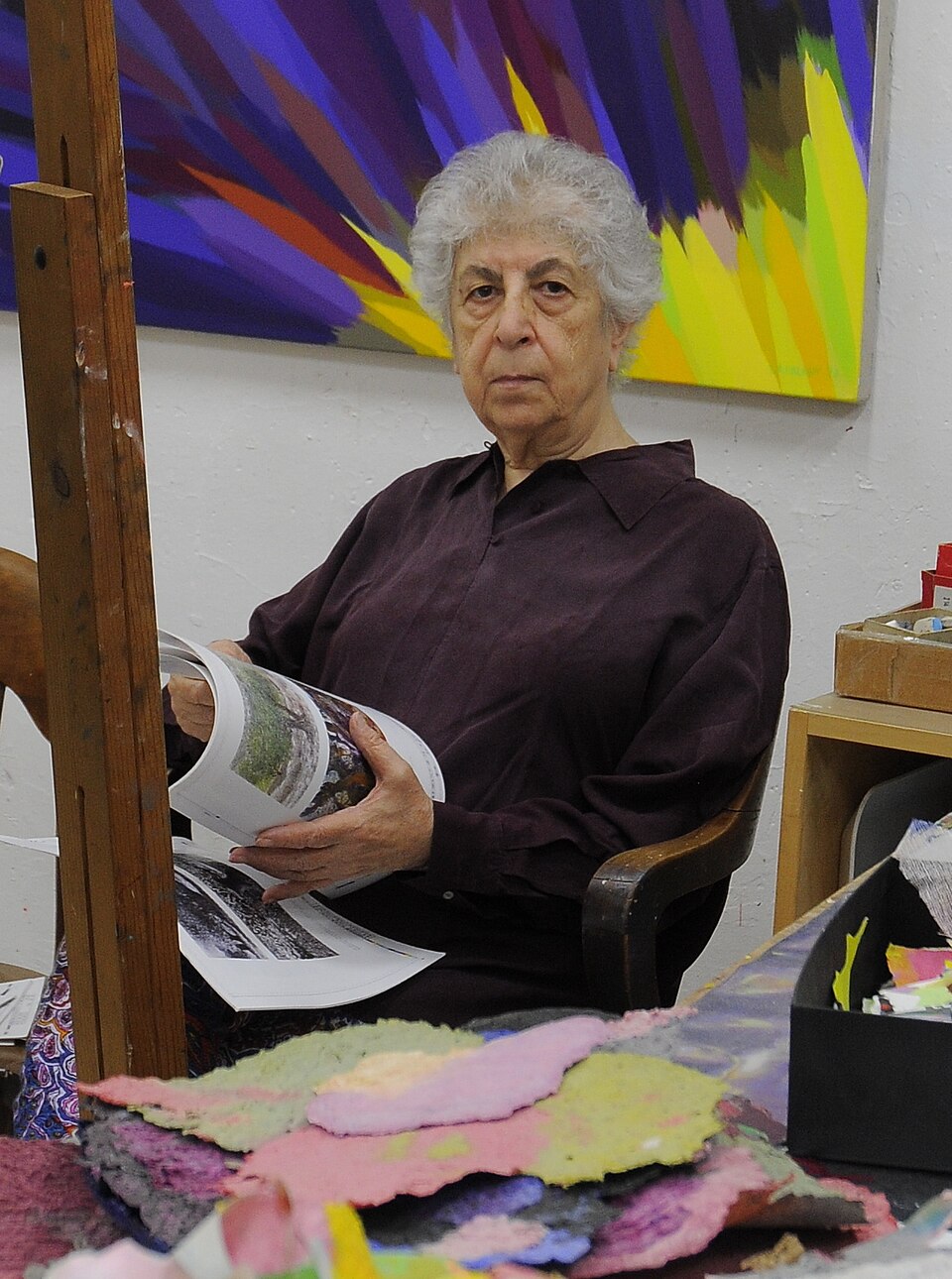
Samia Halaby
سامية حلبي
Born: Jerusalem, Palestine (British Mandate)
Domain: Visual Arts
Recognition: Globally recognized
Member of the Palestinian diaspora
Biography
Samia Halaby is a pioneering Palestinian-American abstract painter, scholar and political activist widely regarded as one of the most important living abstractionists from the Arab world. Born in Jerusalem in 1936, she and her family were displaced during the 1948 Nakba, eventually settling in the United States. She trained at Michigan State University, Indiana University and the Cincinnati Art Academy, building a rigorous foundation in both studio practice and the history of art. Halaby developed a distinctive abstract language rooted in her study of perception, color and motion, drawing equally on European modernism and the visual heritage of Islamic and Arab art. Her canvases explore spatial illusion, geometric structure and the dynamism of light, and she has written extensively about abstraction as a universal human language rather than a purely Western invention. In 1972 she became the first full-time female associate professor at the Yale School of Art, where she taught for a decade, influencing a generation of painters. A committed innovator, she also pioneered "kinetic painting" using early personal computers in the 1980s, programming abstract animations decades before digital art became mainstream. Her scholarship has been as influential as her painting. Her landmark book Liberation Art of Palestine documented the Palestinian art movement, and she has tirelessly championed the work of fellow Palestinian artists. She remains an outspoken advocate for Palestinian rights, integrating activism with her artistic and academic life. A major retrospective, "Samia Halaby: Centers of Energy," affirmed her standing in the international canon, and her works are held in collections including the Solomon R. Guggenheim Museum, the British Museum, the Institut du Monde Arabe and the Cleveland Museum of Art. At nearly nine decades old she continues to paint and write from her New York studio.
Why This Person Matters
Halaby is the foremost Palestinian abstractionist, a trailblazing woman in American academia and an early pioneer of computer-based art who has championed Palestinian art history for half a century.
Historical Context
Samia Halaby was born in Jerusalem in 1936 under the British Mandate, and her family was uprooted during the 1948 Nakba, an expulsion that scattered them before they ultimately settled in the United States. She came of age as an artist within the postwar American academy, training across Michigan, Indiana and Cincinnati at a moment when abstraction dominated Western art yet was rarely credited to non-European traditions. Her breakthrough as the first full-time female associate professor at the Yale School of Art in 1972 placed her at the heart of American art education during a period of feminist advance and contested canons. Her parallel turn to programming kinetic paintings on early personal computers in the 1980s positioned her at the frontier of digital art well before it became mainstream, while her lifelong activism kept her tethered to the Palestinian struggle she had been exiled from as a child.
Historical Context
- — Born in Jerusalem, Palestine (British Mandate)
- — The Nakba – Palestinian catastrophe and mass displacement
- — Six-Day War and occupation of West Bank and Gaza
Selected Works
- Liberation Art Paintings — Abstract expressionist paintings made in response to the Palestinian struggle — using vibrant color fields and gestural mark-making — that earned her a reputation as the most significant Palestinian abstract painter of her generation.
Legacy & Influence
Halaby is widely regarded as the foremost Palestinian abstractionist and one of the most important living abstract painters from the Arab world, her work held in the Guggenheim, the British Museum, the Institut du Monde Arabe and the Cleveland Museum of Art. Her major retrospective, "Centers of Energy," affirmed her place in the international canon, while her landmark book "Liberation Art of Palestine" remains a foundational document of the Palestinian art movement. As a trailblazing woman in American academia and an early pioneer of computer-based art, she shaped generations of painters and helped establish abstraction as a universal rather than purely Western language. Now in her late eighties, she continues to paint, write and advocate for Palestinian rights, remaining a living link between modernist art history and the Palestinian cause.
Topics & Themes
- British Mandate
- Diaspora
- Jerusalem
References & Sources
- Samia Halaby - Solomon R. Guggenheim Museum Collection — https://www.guggenheim.org/artwork/artist/samia-halaby
- Samia Halaby and the Canceled Retrospective — https://www.nytimes.com/2024/02/15/arts/design/samia-halaby-indiana-university-exhibition-canceled.html