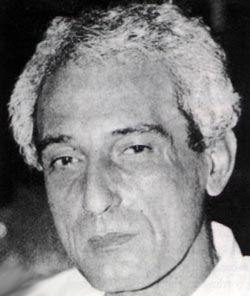
Naji al-Ali
ناجي العلي
Born: al-Shajara, Galilee, Mandatory Palestine
Domain: Visual Arts
Recognition: Globally recognized
Member of the Palestinian diaspora
Biography
Naji Salim Hussain al-Ali was a Palestinian political cartoonist whose biting, uncompromising drawings made him the most celebrated and influential satirist in the modern Arab world. Born around 1937 in the Galilean village of al-Shajara, between Tiberias and Nazareth, he was roughly ten years old when the 1948 Nakba drove his family from their home. They fled north into Lebanon and settled in the Ain al-Hilweh refugee camp near Sidon, the dispossession that would define his entire artistic vision and his sense of himself as a permanent witness to exile. Al-Ali came to drawing through the camps. The novelist and revolutionary Ghassan Kanafani noticed sketches he had scrawled on the camp walls and first published his work in the magazine al-Hurriyya in 1961. After moving to Kuwait in 1963, al-Ali built a career across the Arab press, working as illustrator, editor and cartoonist for publications including al-Tali'a, al-Siyasa, al-Safir and al-Qabas. Over roughly a quarter-century he produced an estimated forty thousand cartoons, a relentless visual chronicle of Palestinian dispossession, Arab authoritarianism, class injustice and the failures of the region's political elites. His enduring creation is Handala, a barefoot, ragged ten-year-old refugee boy who first appeared in 1969 and from 1973 onward turned his back on the viewer, hands clasped behind him. Al-Ali said the boy was frozen at the age he himself had been when expelled from Palestine, and would not turn to face the world, nor grow up, until he could return home. Recurring figures populated his frames alongside Handala: Fatima the steadfast peasant woman embodying the land and resistance, the gaunt and defiant poor man, and the bloated, complicit Arab official. His pen spared no one, attacking Israeli occupation, corrupt Arab regimes and a compromised Palestinian leadership with equal ferocity. That fearlessness made al-Ali powerful and made him enemies across the political spectrum. He was repeatedly threatened, deported and pressured, moving from Kuwait to Lebanon and finally, in 1985, to London to draw for the international edition of al-Qabas. On 22 July 1987 he was shot in the face outside the newspaper's London offices and died five weeks later, on 29 August 1987, at Charing Cross Hospital. His assassination has never been solved; the Metropolitan Police reopened the case in 2017. In 1988 the International Federation of Newspaper Publishers posthumously awarded al-Ali its Golden Pen of Freedom, and he has been widely regarded as one of the greatest cartoonists in Arab history. Handala outlived him completely, becoming a ubiquitous emblem of Palestinian identity, steadfastness and the right of return, stenciled on walls and tattooed on skin across Palestine and its diaspora to this day.
Why This Person Matters
He gave Palestinian dispossession its single most enduring visual symbol, Handala, and was assassinated for a pen that spared neither occupier nor Arab regime nor compromised leadership.
Historical Context
Al-Ali was a child of the Nakba in the most literal sense: expelled from al-Shajara as a boy in 1948, he grew up stateless in the refugee camps of southern Lebanon, the generation whose entire consciousness was formed by loss of homeland. His art emerged from the camps and the wider crucible of Arab nationalism, the Palestinian armed struggle, the catastrophes of 1967 and 1982, and the long disillusionment with Arab governments that paid lip service to Palestine while abandoning it. Working always from exile across Kuwait, Lebanon and London, he spoke for the millions of displaced Palestinians for whom return remained the central, unredeemed demand.
Historical Context
- — Born in al-Shajara, Galilee, Mandatory Palestine
- — The Nakba – Palestinian catastrophe and mass displacement
- — Six-Day War and occupation of West Bank and Gaza
- — Passed away at age 50
Selected Works
- Handala — The ten-year-old Palestinian refugee boy drawn with his back to the viewer and hands clasped behind him, who became the most iconic symbol in Arabic political cartooning. Created in 1969, Handala appeared in tens of thousands of cartoons and is still reproduced worldwide.
- Political Cartoons (1963–1987) — Over 40,000 cartoons published in Arab newspapers across the Arab world, using stark black-and-white imagery to indict Israeli occupation, Arab governments' betrayal, and the dispossession of the Palestinian people.
Legacy & Influence
Decades after his murder, Handala has become arguably the most recognizable symbol of Palestinian identity worldwide, reproduced endlessly on murals, posters, jewelry, social media avatars and protest banners as a shorthand for steadfastness and the right of return. Al-Ali set the moral standard for Arab political cartooning, his refusal to flatter power inspiring generations of journalists and artists across the region. His life and assassination have been the subject of books, films and exhibitions, and his image of the small boy with his back turned endures as an unkillable promise that the exile is not over.
Topics & Themes
- British Mandate
- Diaspora
References & Sources
- Naji al-Ali — Wikipedia — https://en.wikipedia.org/wiki/Naji_al-Ali
- Naji al-Ali, Artist (1936–1987) — Palestinian Journeys / Palquest — https://www.palquest.org/en/biography/14303/naji-al-ali
- Who is Handala, the symbol of Palestinians, and his creator Naji al-Ali? — NPR — https://www.npr.org/2024/02/06/1228097975/handala-naji-al-ali-cartoon-palestinian-symbol