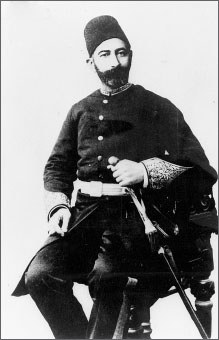
Jiryis (Girgis) Jawhariyyeh
جريس (جرجس) الجوهرية
Born: Jerusalem, Ottoman Palestine
Domain: Music
Recognition: Locally recognized
Biography
Jiryis (Girgis) Jawhariyyeh was a Jerusalemite Greek Orthodox notable, amateur oud player, and civic figure of the late Ottoman city, best remembered today as the father and first musical mentor of the diarist and musician Wasif Jawhariyyeh. The family belonged to the Christian Arab middle class of the walled Old City and lived in Harat al-Sa'diyya (the Saadiyya quarter), the densely woven neighborhood between Bab al-Sahira (Herod's Gate) and the Via Dolorosa, where Muslim and Christian households shared courtyards, festivals, and the soundscape of the muezzin's call. A man of unusual breadth, Jiryis was trained in law and well versed in Muslim Shari'a, commanding Greek, Turkish, and Arabic. In 1884 he was made mukhtar of the Eastern Orthodox community of the Old City and later sat on Jerusalem's municipal council under mayors Salim al-Husayni and Faydi al-Alami. He served briefly as a government tax assessor before turning to private enterprise as a silk farmer in al-Ezariyya (Bethany) and proprietor of a riverside café over the Jraisheh near the spring of 'Ayn Karim's waters. He was also a skilled maker of religious icons, and—of greatest consequence for cultural history—an ear-trained amateur musician who loved the songs of the great Egyptian and Levantine performers of the age. His significance lies in the household he created and the sensibility he transmitted. According to his son's celebrated memoirs, Jiryis kept an open, music-loving home, was among the early Jerusalemites to acquire a phonograph, and listened avidly to recordings of Salama Hijazi, Munira al-Mahdiyya, and other giants of the nahda stage. He pressed the young Wasif to memorize the Qur'an to sharpen his Arabic and ear, and placed an oud in his hands in childhood—seeding the musical vocation that would later make Wasif the chronicler-musician of Jerusalem. Jiryis thus stands as a small but real node in the transmission of Arab musical culture across a Christian Palestinian family. His career was tightly bound to the Husayni family, Jerusalem's leading patrician landlords, for whom he managed estates in the western villages, particularly at Khirbet 'Amro. This patronage relationship shaped the family's fortunes: after Jiryis's death, the young Wasif was effectively taken under the wing of Hussein Effendi al-Husayni, later mayor of Jerusalem—an arrangement that opened doors into the city's elite musical and social life. Jiryis Jawhariyyeh died in Jerusalem around the outbreak of the First World War, before the city passed from Ottoman to British rule. He left no published work of his own; his memory survives almost entirely through the intimate, affectionate portrait drawn in Wasif's diaries, which have become a foundational source for the social and cultural history of Ottoman and Mandate-era Jerusalem. The exact dates of his birth and death are not securely documented.
Why This Person Matters
He was the music-loving Jerusalemite father and first oud teacher of Wasif Jawhariyyeh, seeding the vocation behind one of the richest memoirs of late-Ottoman Palestine.
Historical Context
Jiryis lived in the cosmopolitan, intercommunal Jerusalem of the late Ottoman Tanzimat and Hamidian decades, when Christian Arab notables like the Jawhariyyehs participated fully in municipal governance, Husayni patronage networks, and a shared Arab cultural life that cut across religious lines. His career—mukhtar, councilman, estate manager, café-keeper, icon-maker, and amateur musician—exemplifies the layered, adaptive lives of Old City notables before the rupture of the First World War and the British Mandate transformed the city's politics and demography.
Historical Context
- — Born in Jerusalem, Ottoman Palestine
- — The Nakba – Palestinian catastrophe and mass displacement
- — Six-Day War and occupation of West Bank and Gaza
- — Passed away at age 50
Selected Works
- Jerusalem Qanun Music — A virtuoso of the qanun (zither), Jawhariyyeh performed at the courts of the late Ottoman period and helped define the sophisticated urban musical culture of Jerusalem in the early 20th century.
Legacy & Influence
Jiryis's lasting influence is indirect but profound: by raising a musical, observant, festival-loving household and placing an oud in his son's hands, he set in motion the formation of Wasif Jawhariyyeh, whose diaries are now a cornerstone source for the social, musical, and everyday history of Jerusalem—ensuring the father survives as the affectionately drawn origin point of that legacy.
Topics & Themes
- Ottoman Era
- Jerusalem
References & Sources
- Wasif Jawhariyyeh (Wikipedia) — https://en.wikipedia.org/wiki/Wasif_Jawhariyyeh
- Wasif Jawhariyyeh — Interactive Encyclopedia of the Palestine Question (palquest) — https://www.palquest.org/en/biography/6569/wasif-jawhariyyeh
- Jerusalem's Ottoman Modernity: The Times and Lives of Wasif Jawhariyyeh — Institute for Palestine Studies — https://www.palestine-studies.org/en/node/78121