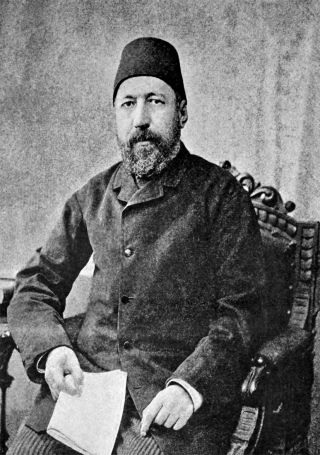
Yusuf Diya al-Khalidi
يوسف ضياء الدين باشا الخالدي
Born: Jerusalem, Ottoman Palestine
Domain: Politics & Diplomacy
Recognition: Regionally recognized
Biography
Yusuf Diya al-Khalidi was born in 1842 in Jerusalem into the al-Khalidi family, one of the city's oldest and most distinguished notable households, long associated with religious scholarship, judgeships in the Sharia courts, and the celebrated Khalidiyya Library. His father, Muhammad Ali al-Khalidi, served in the Jerusalem Sharia court establishment, and the young Yusuf Diya broke with convention by pursuing an unusually cosmopolitan education: he studied at a Protestant college in Malta, where he learned English and French, and later attended the Imperial Medical School and Robert College in Constantinople, acquiring a command of European languages and ideas rare among his generation of Palestinian Arabs. His public career spanned the worlds of municipal administration, imperial diplomacy, parliamentary politics, and scholarship. He served as mayor of Jerusalem across several terms between the 1870s and his death, presiding over the modernizing Ottoman municipality during a period of rapid change in the holy city. He held Ottoman governorships and consular and translation posts, and for a time taught Semitic and Oriental languages at the Imperial Oriental Academy in Vienna. As a scholar he compiled what is regarded as one of the first Kurdish-Arabic dictionaries, a pioneering work of comparative philology. In 1876–1877 al-Khalidi was elected to represent Jerusalem in the first Ottoman Parliament convened under the new constitution, where he emerged as one of its most outspoken liberal voices, defending constitutional government and challenging Sultan Abdülhamid II's authority — a boldness that contributed to his subsequent political marginalization when the parliament was suspended. He is best remembered today for a remarkably prescient letter he wrote on 1 March 1899 to Theodor Herzl, founder of political Zionism, sent via Zadok Kahn, the chief rabbi of France. In it al-Khalidi acknowledged the historical and emotional Jewish attachment to Palestine — "in theory the idea is entirely natural, fine and just" — yet warned with striking clarity that Palestine was already inhabited by a settled population and that the Zionist project would, in practice, provoke conflict and suffering. He closed with the appeal that "in the name of God, let Palestine be left in peace." Herzl's reply of 19 March 1899 is among the earliest documented exchanges between a Zionist leader and an Arab notable, and al-Khalidi's letter stands as perhaps the earliest cogent Palestinian articulation of the dangers Zionism posed. Al-Khalidi died on 25 January 1906, at the age of sixty-three or sixty-four. He left behind a body of scholarship, a record of constitutional reformism, and a single letter whose foresight has made him, more than a century later, a touchstone for understanding the origins of the Palestine question.
Why This Person Matters
His 1899 letter to Theodor Herzl is perhaps the earliest clear-eyed Palestinian warning that Zionism, however understandable its aspirations, would collide with the rights of Palestine's existing inhabitants.
Historical Context
Al-Khalidi lived through the late Ottoman era of the Tanzimat reforms, the brief 1876 constitution, and the centralizing autocracy of Abdülhamid II — a period when Palestine was an integral part of the empire and its Arab notables navigated between Istanbul, local autonomy, and the new currents of European nationalism. Writing two years after Herzl convened the First Zionist Congress at Basel in 1897, he grasped, decades before the Balfour Declaration and the British Mandate, that organized Jewish immigration to an already-populated Palestine would become the central conflict of the coming century.
Historical Context
- — Born in Jerusalem, Ottoman Palestine
- — The Nakba – Palestinian catastrophe and mass displacement
- — Six-Day War and occupation of West Bank and Gaza
- — Passed away at age 64
Legacy & Influence
For modern Palestinians and historians alike, al-Khalidi's letter has become a foundational document, quoted prominently in works such as Rashid Khalidi's "The Hundred Years' War on Palestine" — a reminder that Palestinian objections to Zionism were articulated thoughtfully and early, by a worldly, multilingual statesman who admired Jewish history even as he foresaw the human cost of dispossession. His reformist parliamentary record and his pioneering scholarship further mark him as an emblem of an open, cosmopolitan, late-Ottoman Palestinian intellectual class.
Topics & Themes
- Ottoman Era
- Jerusalem
References & Sources
- Yousef al-Khalidi — Wikipedia — https://en.wikipedia.org/wiki/Yousef_al-Khalidi
- Yusuf Diya' al-Khalidi — Jerusalem Story — https://www.jerusalemstory.com/en/bio/yusuf-diya-al-khalidi
- Yusuf Diya-uddin al-Khalidi — Interactive Encyclopedia of the Palestine Question (palquest) — https://www.palquest.org/en/biography/39653/yusuf-diya-uddin-al-khalidi