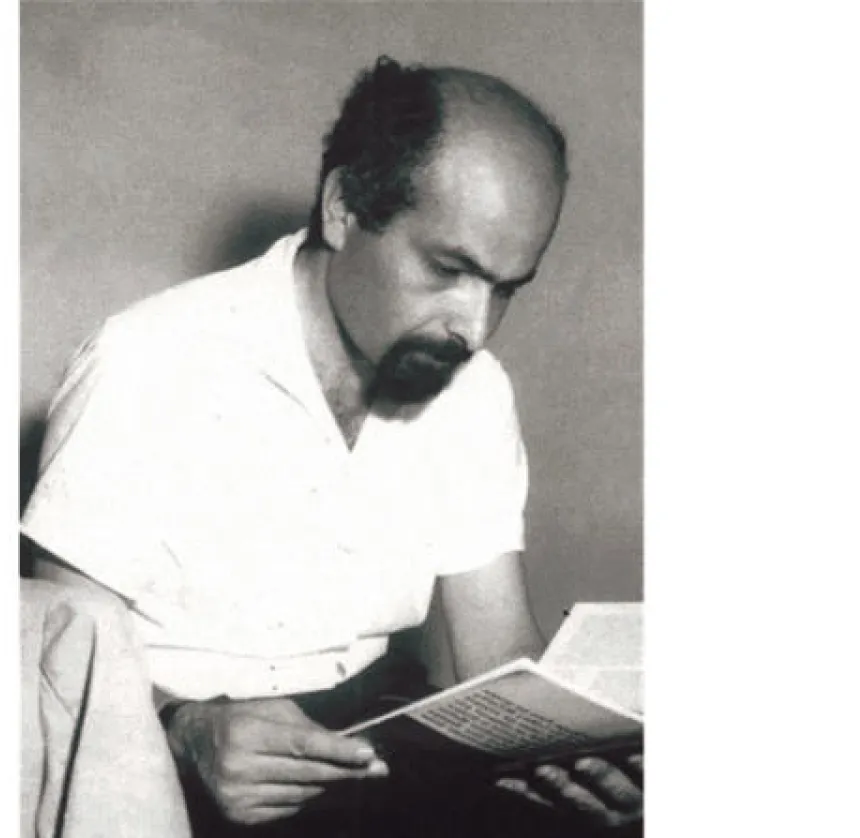
Tawfiq Sayigh
توفيق صايغ
Born: Kharaba, Syria
Domain: Literature & Poetry
Recognition: Regionally recognized
Member of the Palestinian diaspora
Biography
Tawfiq Sayigh was a Palestinian poet, translator, and editor regarded as one of the most original and uncompromising modernists in twentieth-century Arabic poetry. Born in 1923 in Syria to a Palestinian Protestant minister's family, he was raised in Tiberias and Palestine and educated at the American University of Beirut, later studying at Oxford and Harvard. He was among the earliest and boldest practitioners of the Arabic prose poem (qasidat al-nathr), breaking decisively with classical meter and rhyme in collections such as "Thalathun Qasida" (Thirty Poems) and "Mu'allaqat Tawfiq Sayigh." His verse, dense with biblical allusion, existential anguish, and unrequited love, was difficult and personal at a time when much Arabic poetry was turning to collective political address, and it has come to be seen as a courageous expansion of the form's possibilities. As editor of the influential cultural review "Hiwar" in Beirut during the 1960s, he became a central figure in Arab intellectual life, publishing leading writers and provoking fierce debate. The journal's funding controversy (later revealed ties to the Congress for Cultural Freedom) ended the magazine and wounded him deeply, but did not diminish the literary significance of what he had built. A gifted translator, he produced an acclaimed Arabic rendering of T. S. Eliot's "Four Quartets," further bridging Anglo-American modernism and Arabic letters. He spent his later years teaching in the United States and died in Berkeley, California, in 1971. Though less widely known to general readers than some contemporaries, Sayigh is esteemed by poets and critics as a pioneer whose radical experimentation helped open Arabic poetry to new forms, securing his standing as a major modernist of Palestinian origin.
Why This Person Matters
A pioneer of the Arabic prose poem and editor of the landmark journal Hiwar, he expanded the formal horizons of modern Arabic poetry from a distinctly Palestinian sensibility.
Historical Context
Tawfiq Sayigh came of age in the twilight of Mandate Palestine, raised in Tiberias in a Protestant minister's household before the 1948 Nakba scattered his family and severed him from the Galilee of his youth. His formation at the American University of Beirut, then at Oxford and Harvard, placed him at the meeting point of Arab cultural ferment and Anglo-American modernism in the postwar decades. He wrote at a moment when Arabic poetry was convulsed between the rising free-verse movement and a poetry of collective political address, yet he turned inward toward private anguish and exile. His editorship of Hiwar in 1960s Beirut, the cultural capital of the Arab world, set him at the center of Cold War-era debates over literature, independence, and patronage that ultimately consumed the journal.
Historical Context
- — Born in Kharaba, Syria
- — The Nakba – Palestinian catastrophe and mass displacement
- — Six-Day War and occupation of West Bank and Gaza
- — Passed away at age 48
Selected Works
- Thirty Poems — His 1954 debut collection introduced free verse to Arabic poetry with exceptional psychological depth, marking him as one of the founders of modernism in Arabic literature.
Legacy & Influence
Sayigh is remembered as a founding father of the Arabic prose poem, whose collections "Thalathun Qasida" and his "Mu'allaqa" proved that Arabic could carry an intensely personal, biblically charged modernism free of meter and rhyme. Poets and critics who once found him too difficult now treat him as a courageous pioneer who widened the formal horizons later traveled by Unsi al-Hajj and the Shi'r generation. His Arabic rendering of T. S. Eliot's "Four Quartets" remains a touchstone of literary translation between English and Arabic modernism. Though Hiwar's funding scandal wounded him, the journal's brief brilliance is itself part of his legacy, and his reputation has steadily risen with new editions, scholarship, and his enduring standing as a major Palestinian modernist.
Topics & Themes
- British Mandate
- Diaspora
References & Sources
- Tawfiq Sayigh — Banipal — https://www.banipal.co.uk/contributors/2240/tawfiq-sayigh/
- Tawfiq Sayigh — https://en.wikipedia.org/wiki/Tawfiq_Sayigh