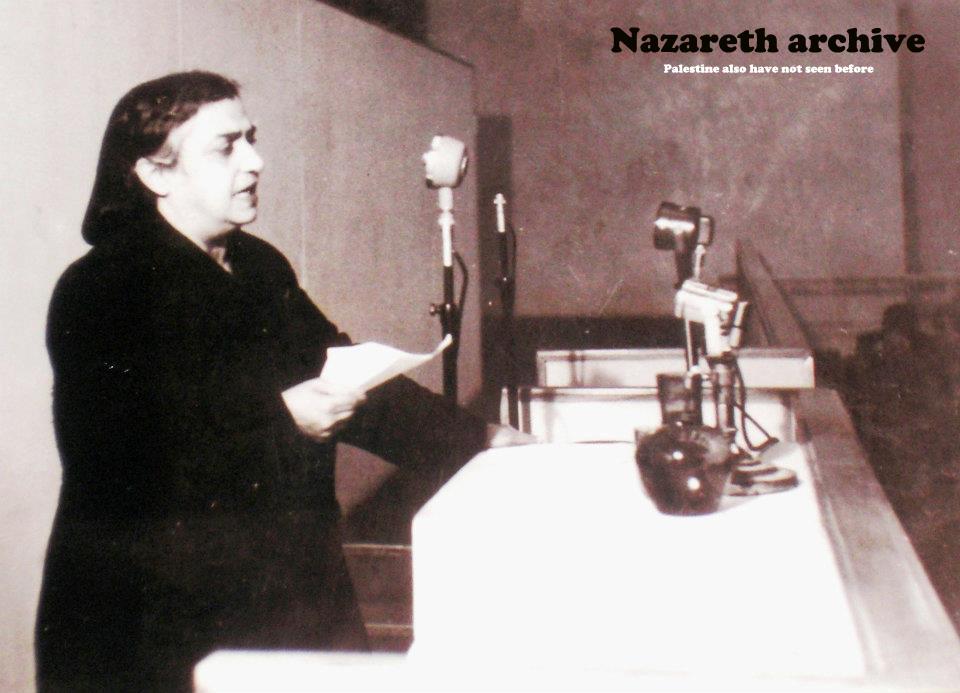
Sadhij Nassar
ساذج نصّار
Born: Acre, Ottoman Palestine
Domain: Journalism & Media
Recognition: Regionally recognized
Biography
Sadhij Nassar was born around 1900 in Acre, then part of Ottoman Palestine, into a family of Baha'i background; her father, Shaykh Badi'ullah, was of Iranian origin. She came of age in the final years of Ottoman rule and the early years of the British Mandate, an era in which the Palestinian press was emerging as a central instrument of national consciousness. In 1927 she married Najib Nassar, the veteran journalist and founder of the Haifa newspaper al-Karmil, who had earlier been her Arabic teacher and was some three decades her senior. Through this partnership she entered the world of journalism and anti-Zionist politics that would define her life. Nassar's professional career began in 1923, when she started contributing articles to al-Karmil, the pioneering paper her husband had founded in Haifa in 1908. In 1926 she launched and edited a dedicated "Women's Section" addressing social questions, to which both men and women contributed. Her writing carried an unusually emancipatory spirit for its time: she urged Palestinian mothers to raise sons and daughters as equals, demanded education and employment for women, denounced entrenched social ills, and pressed women to enter political life and join the struggle against British and Zionist colonialism. She effectively co-ran al-Karmil and became one of the most prominent women's voices in the Palestinian press. Beyond the page, Nassar was an organizer. In 1930, together with Mariam al-Khalil, she co-founded the Arab Women's Union in Haifa, which became a significant force during the 1936 General Strike and the wider Arab Revolt. She took part in Arab women's congresses and joined the Palestinian women's delegation to the Eastern Women's Congress for the Defense of Palestine held in Cairo in October 1938 at the invitation of the Egyptian feminist Huda Sha'rawi, where she was elected secretary of the congress bureau. In late 1938 Nassar became the first Palestinian woman imprisoned by the British Mandate authorities for nationalist activity. Charged with supplying arms to the rebels and branded by the British as a "very dangerous woman" and a "prominent agitator," she was held without trial at the Bethlehem women's detention camp for roughly eleven months. Her husband Najib reportedly wrote that even if al-Karmil did not secure his place in history, his wife would—as the first woman to enter the cells of the British occupation. Najib Nassar died at the end of 1947, and in the Nakba of 1948 Sadhij and her son were displaced from Palestine to Lebanon. She continued her journalism in exile, writing for the Lebanese paper al-Yawm and, after settling in Damascus, contributing to Syrian newspapers including al-Qabas. She died in 1970, remembered as a foundational figure of Palestinian women's journalism and political organizing.
Why This Person Matters
She was a pioneer of Palestinian women's journalism and the first Palestinian woman jailed by the British Mandate for nationalist activity.
Historical Context
Nassar's life spanned the collapse of Ottoman Palestine and the full arc of the British Mandate, when the Palestinian press and an emergent women's movement became twin engines of anti-colonial nationalism. Working from Haifa through the 1936–39 Arab Revolt, she belonged to the generation of educated women who moved from charitable and social activity into open political mobilization against the Balfour Declaration, Zionist land purchase, and British rule—culminating for her in imprisonment and, in 1948, in the dispossession of the Nakba.
Historical Context
- — Born in Acre, Ottoman Palestine
- — The Nakba – Palestinian catastrophe and mass displacement
- — Six-Day War and occupation of West Bank and Gaza
- — Passed away at age 70
Legacy & Influence
Sadhij Nassar is remembered as a founding figure of women's journalism in Palestine and a model of the activist-editor who fused feminism, education, and anti-colonial nationalism. Her "Women's Section" in al-Karmil, her co-founding of the Arab Women's Union in Haifa, and her imprisonment by the British have made her a recurring reference point in histories of the Palestinian women's movement and the Arabic press, invoked anew in contemporary writing on women's resistance and on International Women's Day.
Topics & Themes
- Ottoman Era
References & Sources
- Sadhij Nassar — Wikipedia — https://en.wikipedia.org/wiki/Sadhij_Nassar
- Sadhij Nassar — Palestinian Journeys / Interactive Encyclopedia — https://www.palquest.org/en/biography/14231/sadhij-nassar
- Sadhij Nassar (1900–1970) — Institute for Palestine Studies — https://www.palestine-studies.org/en/node/1651244