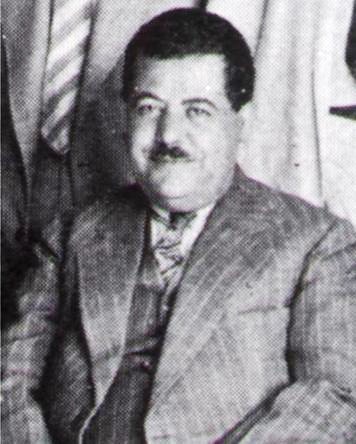
Muhammad Izzat Darwaza
محمد عزة دروزة
Born: Nablus, Ottoman Palestine
Domain: Academia & Thought
Recognition: Regionally recognized
Biography
Muhammad Izzat Darwaza was born in 1888 into a middle-class Sunni Muslim merchant family in Nablus, a city long embedded in the textile and trade networks linking Palestine with Beirut and Damascus. He received his elementary and preparatory schooling in Ottoman state schools, where alongside Arabic he acquired Turkish and English and a basic command of French. Largely an autodidact thereafter, he entered the Ottoman postal and telegraph administration as a young man, a bureaucratic career that carried him across Palestine and Lebanon and gave him an intimate view of the late-imperial Arab provinces on the eve of their dismemberment. The Arab Revolt of 1916 crystallized Darwaza's lifelong commitment to Arab nationalism. He joined the secret society al-Fatat, became a leading advocate of the unity of Greater Syria, and emerged as one of the most active organizers of the Palestinian national movement. He served as secretary of the First Palestine Arab Congress and was a founding figure of the radical, anti-colonial Istiqlal (Independence) Party in 1932, opposing both Zionist settlement and the British and French mandates with uncompromising clarity. From 1922 to 1927 he directed the an-Najah National School in Nablus, where he built an explicitly Arab-nationalist curriculum that shaped a generation of Palestinian students. Darwaza matters as one of the intellectual architects of modern Palestinian and pan-Arab nationalism. A prolific writer, by the end of his life he had produced more than thirty books and countless articles on the Palestine question, Arab history, and Islam. His pioneering survey, "Lessons in the History of the Arabs," was among the first modern narrative histories written for an Arab readership, tracing the Semitic peoples, the rise of Islam, and the long arc of foreign domination. His memoirs remain an essential primary source for historians of the Mandate period. Imprisoned and exiled by the British during the 1936-1939 Arab Revolt, Darwaza spent years in Damascus and in Turkey, where the libraries of Bursa gave him the leisure to draft his major religious work. The result was "al-Tafsir al-Hadith" (The Modern Exegesis), a complete commentary on the Qur'an arranged in the chronological order of revelation rather than the canonical sequence, written to reach a modern Muslim youth alienated by the classical tradition. In 1946 he joined Hajj Amin al-Husseini's Arab Higher Committee but resigned the following year. Darwaza spent his final decades in Damascus, where he died on 26 June 1984 at the age of ninety-six, having outlived the Palestine he had fought for and bequeathing a vast written legacy to the national movement.
Why This Person Matters
He was a founding intellectual of modern Palestinian and pan-Arab nationalism whose histories, memoirs, and chronological Qur'an commentary shaped a century of Arab thought.
Historical Context
Darwaza's life spanned the entire formative arc of modern Palestinian history: born under late-Ottoman rule, he came of age in the Arab nationalist ferment of World War I and the Arab Revolt, helped organize Palestinian political life under the British Mandate through the Arab congresses and the Istiqlal Party, was imprisoned and exiled during the 1936-1939 revolt, and lived through the 1948 Nakba and the catastrophe of dispossession into the 1980s. He belonged to the generation of urban notables and self-made intellectuals who transformed scattered anti-Zionist and anti-colonial sentiment into an organized national movement.
Historical Context
- — Born in Nablus, Ottoman Palestine
- — The Nakba – Palestinian catastrophe and mass displacement
- — Six-Day War and occupation of West Bank and Gaza
- — Passed away at age 96
Legacy & Influence
Darwaza left a double legacy that endures across the Arab world: as a historian and memoirist whose works remain indispensable primary and secondary sources for scholars of Palestine and Arab nationalism, and as a Qur'anic exegete whose "al-Tafsir al-Hadith," organized by the order of revelation, became a landmark of modern reformist tafsir still studied and debated in religious scholarship today. His writings continue to be cited by historians, drawn upon by the Palestinian national narrative, and analyzed in contemporary Islamic studies.
Topics & Themes
- Ottoman Era
- West Bank
References & Sources
- Izzat Darwaza — https://en.wikipedia.org/wiki/Izzat_Darwaza
- Muhammad Izzat Darwaza — Interactive Encyclopedia of the Palestine Question — https://www.palquest.org/en/biography/34123/muhammad-izzat-darwaza
- Muhammad Izzat Darwaza (1887-1984) — Institute for Palestine Studies — https://www.palestine-studies.org/en/node/1655894