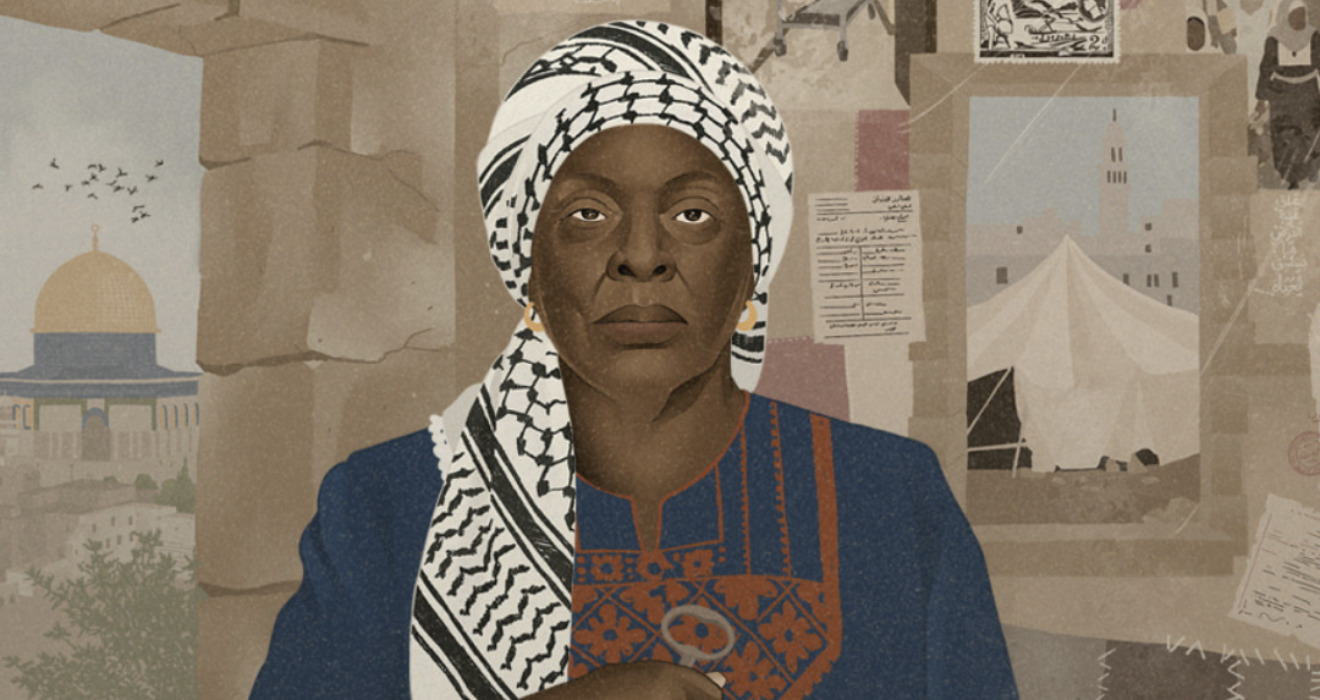
Fatima Bernawi
فاطمة برناوي
Born: Jerusalem, Mandatory Palestine
Domain: Politics & Diplomacy
Recognition: Regionally recognized
Member of the Palestinian diaspora
Biography
Fatima Bernawi was born in 1939 in Jerusalem's African Quarter — the historic neighbourhood beside Al-Aqsa Mosque where West African pilgrims had settled for centuries, standing guard at the holy site in an unbroken tradition stretching back to the medieval era. Her father was Nigerian and her mother Palestinian-Jordanian, making her one of the most visible figures of Afro-Palestinian identity in the twentieth century. She grew up immersed in the multilayered world of the African Quarter, where Yoruba, Arabic, and the liturgical rhythms of the mosque all formed the texture of daily life. In 1948, when Fatima was nine, the Nakba shattered that world. As Zionist forces seized the city and the State of Israel was declared, she fled with her mother to a refugee camp in Jordan while her father remained behind. The experience of displacement — watching her family and community torn apart, searching as a child for any magic that might undo the catastrophe — would shape the rest of her life. 'I used to look for Solomon's Ring thinking I could rub it and the genie would tell me, "I'll do anything you want." Then I could solve my family's misery,' she later recalled. Trained as a nurse, Bernawi returned to Jerusalem after the city's fall under full Israeli military occupation following the 1967 Six-Day War. Radicalised by the occupation she witnessed firsthand, she joined the Palestinian National Liberation Movement — Fatah. In late 1967 she took part in a commando operation, planting explosives at the Zion Cinema in Jerusalem, which was screening a film celebrating Israel's 1967 military victory. The device never detonated, but Bernawi was arrested. She became the first woman to be detained by the Israeli Occupation Forces, a fact that gave her case immediate symbolic weight across the Arab world. Sentenced to life imprisonment, she endured years of incarceration while her younger sister — seized by soldiers who mistook her for Fatima — was also held for a year. Bernawi remained defiant throughout. 'The reason for these military operations was, and still is, to tell the Israeli occupation that we defy it,' she said. She was released after approximately ten years and continued her commitment to the Palestinian national movement, becoming an enduring symbol of resistance, female courage, and Afro-Palestinian identity in Palestinian collective memory.
Why This Person Matters
Bernawi was the first woman arrested by Israeli Occupation Forces and an emblematic figure of Afro-Palestinian identity. Her story bridges Jerusalem's centuries-old African community, the 1948 Nakba, and the 1967 resistance movement, embodying the full arc of Palestinian dispossession and defiance.
Historical Context
Bernawi's life spanned the full transformation of Palestinian society in the twentieth century. Jerusalem's African Quarter had existed for over five centuries, sustained by West African Muslim pilgrims who chose to remain in the Holy City as its custodians. The community was deeply integrated into the social and religious fabric of Ottoman and Mandate-era Jerusalem. The 1948 Nakba dismantled this world, displacing hundreds of thousands and creating the refugee crisis that remains unresolved. When Israel occupied the West Bank and East Jerusalem in June 1967, a new phase of resistance began. Fatah, founded by Yasser Arafat in the late 1950s, had emerged as the dominant Palestinian liberation organisation, and the 1967 defeat galvanised a generation of fighters. Bernawi's operation took place in that charged atmosphere of humiliation and defiance, and her arrest as the first female political prisoner transformed her into an immediate symbol at a pivotal moment in Palestinian national consciousness.
Historical Context
- — Born in Jerusalem, Mandatory Palestine
- — The Nakba – Palestinian catastrophe and mass displacement
- — Six-Day War and occupation of West Bank and Gaza
- — Passed away at age 82
Legacy & Influence
Fatima Bernawi is remembered in Palestinian national memory as a pioneer of female political resistance. Her status as the first woman imprisoned by Israeli forces gave her an emblematic role in the broader story of Palestinian women's participation in the liberation struggle, paving the way for generations of female activists, lawyers, and fighters who followed. Her Afro-Palestinian background has also given her story renewed significance in the twenty-first century, as scholars and communities explore the long history of the African diaspora in Jerusalem and its suppression. She passed away in 2021, mourned across Palestinian political society as a foundational figure of the resistance generation.
Topics & Themes
- British Mandate
- Diaspora
- Jerusalem
References & Sources
- Fatima Bernawi — Wikipedia — https://en.wikipedia.org/wiki/Fatima_Bernawi
- Fatima Bernawi, first female Palestinian political prisoner, dies — https://www.aljazeera.com/features/2021/1/14/fatima-bernawi-first-female-palestinian-political-prisoner-dies
- Fatima Bernawi, first Palestinian woman held by Israelis, dies aged 81 — https://www.middleeasteye.net/news/fatima-bernawi-first-palestinian-female-prisoner-held-israelis-dies-aged-81