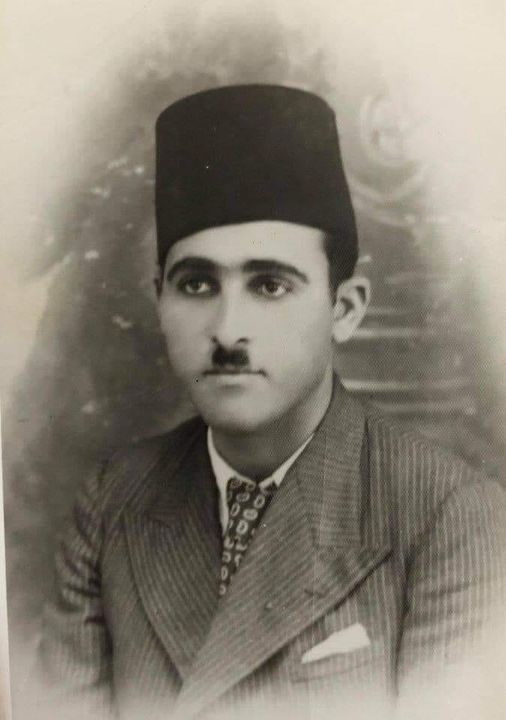
Abd al-Rahim Mahmud
عبد الرحيم محمود
Born: Anabta, Mandatory Palestine
Domain: Literature & Poetry
Recognition: Regionally recognized
Biography
Abd al-Rahim Mahmud was born in 1913 in the small town of Anabta, east of Tulkarm in the Galilee-facing hill country of northern Palestine, then under nascent British military rule and soon the Mandate. His father, Shaykh Mahmud Abd al-Halim, was a graduate of al-Azhar and a religious scholar of the Hanbali school, and the household steeped the boy early in classical Arabic learning. He completed his primary schooling in Anabta in 1925, his intermediate years in Tulkarm, and his secondary studies at the National Najah School (al-Najah) in Nablus, where he excelled in Arabic language and literature and came of age in the orbit of the poet Ibrahim Tuqan. He returned to al-Najah as a teacher of Arabic language and literature, becoming one of the most admired younger voices of Palestine's interwar literary scene. He published verse and essays in the press of the day, including the newspaper al-Ittihad and the magazine al-Ghad, and read his poems at the great public gatherings where Palestinian nationalism was being forged. His poetry fused the polished diction of the classical qasida with an urgent, openly political content: defiance of British colonial rule, warning against Zionist colonization and land sales, and an exalted, almost ecstatic readiness for martyrdom. His life refused the boundary between pen and rifle. Mahmud took part in the Great Palestinian Revolt of 1936-1939 against British rule; after its suppression he sought refuge in Iraq, where in 1939 he entered the Military College and graduated as a second lieutenant. He came back to Palestine and resumed teaching, but as the 1948 catastrophe gathered he set down the classroom for the battlefield, joining the Arab Liberation Army (Jaysh al-Inqadh) in January 1948. On 13 July 1948 he fought at the Battle of al-Shajara in the lower Galilee, where shrapnel from a shell struck him in the neck and face; he died of his wounds that day. He was thirty-five. His death gave a literal, harrowing fulfillment to the most famous lines he had written: \"I shall carry my soul in my palm / and cast it into the abysses of death\" — verse that had long foretold the manner of his end and earned him forever the title al-Shahid (the martyr poet). His surviving output, gathered posthumously into a collected diwan, is slender by the measure of long-lived poets but disproportionately resonant. Poems such as al-Shahid (The Martyr) and his address to the Saudi prince visiting al-Aqsa entered the canon of Palestinian and pan-Arab nationalist verse, recited by generations of schoolchildren and protesters. He stands at the head of the lineage of the Palestinian \"poet-fighter\" that later figures, from Abu Salma to the resistance poets of the 1960s, would consciously inherit.
Why This Person Matters
He is the archetypal Palestinian "martyr poet," whose verse vowing to fling his soul into death was literally fulfilled when he was killed fighting in 1948.
Historical Context
Mahmud's life spans the formative decades of Palestinian national consciousness under the British Mandate. Born as the Ottoman order collapsed, he matured amid mounting Jewish immigration, land sales, and the political mobilization that erupted in the 1936-1939 Great Revolt, in which he took part before exile in Iraq. His generation of Mandate-era educators and poets — Ibrahim Tuqan, Abu Salma, Mahmud's own circle at al-Najah — turned classrooms and literary platforms into instruments of resistance. His death at al-Shajara in July 1948 placed him squarely in the Nakba, the destruction and dispossession that transformed Palestinian society and gave his prophetic verse its terrible authority.
Historical Context
- — Born in Anabta, Mandatory Palestine
- — The Nakba – Palestinian catastrophe and mass displacement
- — Six-Day War and occupation of West Bank and Gaza
- — Passed away at age 35
Selected Works
- The Martyr — Written in the 1930s, this poem's opening lines — 'I shall carry my soul in my palm and fling it into the abyss of death' — became among the most recited lines in Palestinian poetry, adopted as an anthem of sacrifice.
Legacy & Influence
Though his collected work is small, Abd al-Rahim Mahmud became one of the most recited poets in the Arab world, his verses on sacrifice and homeland memorized in classrooms from Morocco to Iraq and chanted at Palestinian demonstrations to this day. He defined the enduring ideal of the poet who lives and dies by what he writes, directly shaping the Palestinian resistance-poetry tradition that culminated in Mahmoud Darwish and Samih al-Qasim. Schools, cultural centers, and literary prizes bear his name, and his line "I shall carry my soul in my palm" has become a proverb of Palestinian steadfastness.
Topics & Themes
- Ottoman Era
References & Sources
- Abd al-Rahim Mahmoud — Palestinian Journeys / Interactive Encyclopedia of the Palestine Question — https://www.palquest.org/en/biography/14589/abd-al-rahim-mahmoud
- Abd al-Rahim Mahmoud (1913-1948) — Institute for Palestine Studies — https://www.palestine-studies.org/en/node/1651459
- Abd al-Rahim Mahmud — Arabic Wikipedia — https://ar.wikipedia.org/wiki/عبد_الرحيم_محمود